By the Our Home to Yours Workshop Team | Published: 5 November 2026 | Updated: 5 November 2026
The quick answer: Holiday let storage has to be obvious, wipeable and repairable. Open shelving beats cupboards because guests will not open a door they cannot see into, wall-mounted pieces free the floor for cleaning between stays, and solid wood can be sanded back rather than replaced when it gets knocked.
Furnishing a property you do not live in is a different exercise from furnishing your own home, and holiday let storage is where that difference shows up fastest. Your own storage can be learned. A guest has four days and will never learn it — they will either see where something goes in the first ten seconds, or they will leave it on the worktop.
This is a guide to the storage decisions specifically, written from the furniture side rather than the hosting side. It assumes you already have the regulatory basics in hand, and focuses on what to actually put on the walls.
The rules before the furniture
Two things are worth checking before you buy anything, because both can change what you are allowed to put where.
First, the legal framework. GOV.UK’s guidance on letting out a self-catering holiday home in England covers planning permission, business rates, insurance and a mandatory national registration scheme for short-term lets that the government is introducing. The same page confirms the Furnished Holiday Let tax regime was abolished on 6 April 2025, so short-term letting income is now taxed under the usual residential landlord rules.
Second, fire safety. The Home Office publishes guidance on making small paying guest accommodation safe from fire, issued under Article 50 of the Regulatory Reform (Fire Safety) Order 2005, and it applies to self-catering properties with a simple layout and a small number of guest bedrooms. It matters here because escape routes are the one place where a nice piece of furniture is the wrong answer.
The practical upshot for storage: keep hallways, landings and stairwells clear. That usually means wall-mounted rather than freestanding anywhere on a route out of the building, and it is worth confirming with your own fire risk assessment rather than taking a general rule from an article. Check with your local authority and fire service if anything is unclear.
Why open beats closed in a let
In your own kitchen, a closed cupboard is tidier. In a let it is a dead zone.
Guests do not rummage. They will use what is visible and buy duplicates of what is not — which is why hosts find three bottles of olive oil and four packs of dishwasher tablets at every changeover. Open shelving, hooks and racks are self-documenting: the storage tells the guest what goes there without a laminated sign.
There is a cleaning argument too. Open storage is inspected in a glance. A cleaner working through a two-hour changeover will check an open shelf every single time and a closed cupboard only sometimes, which is exactly how a let ends up with something unpleasant behind a door in August.
Room by room: what actually earns its place
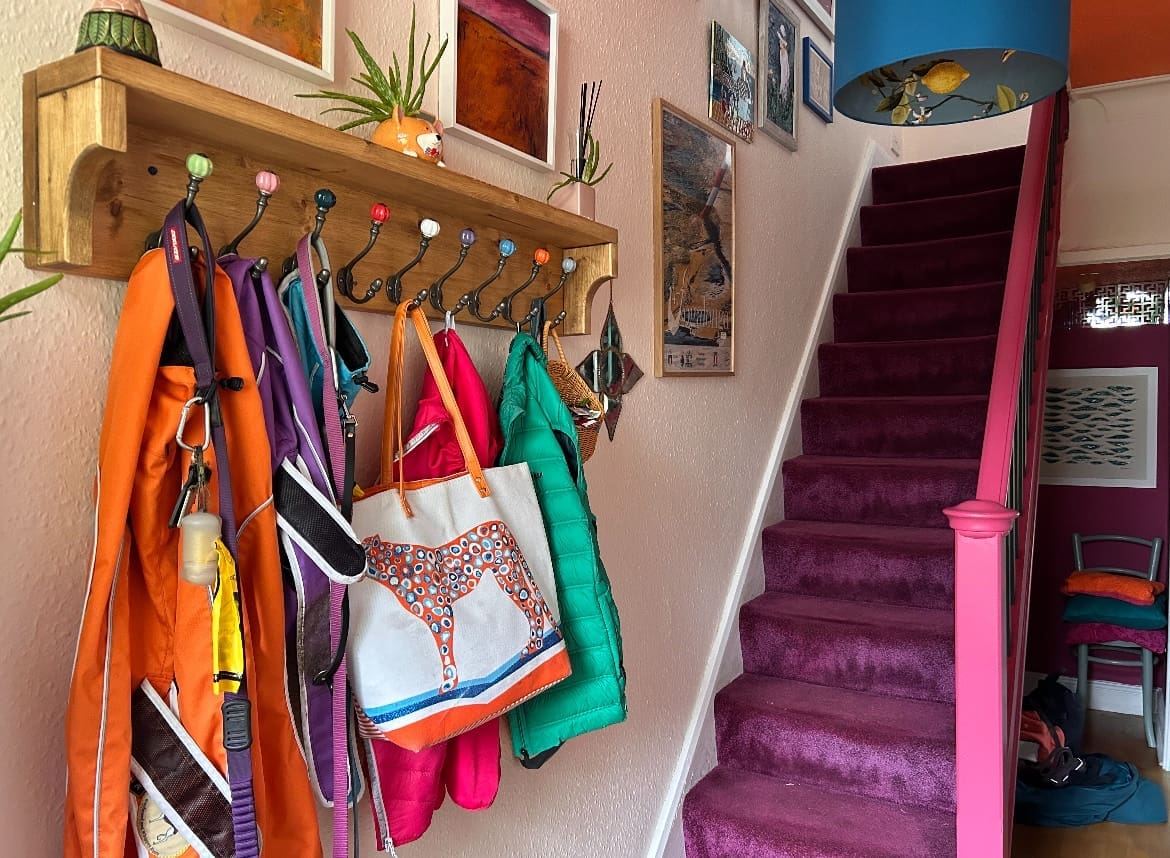
Entrance. A solid hook rail is the highest-value single piece in most lets. Guests arrive with coats, wet waterproofs and bags, and without hooks all of it goes on a dining chair for the week. Fix it to a timber back rail rather than using individual hooks, so the load spreads and nothing pulls out of the wall in season three.
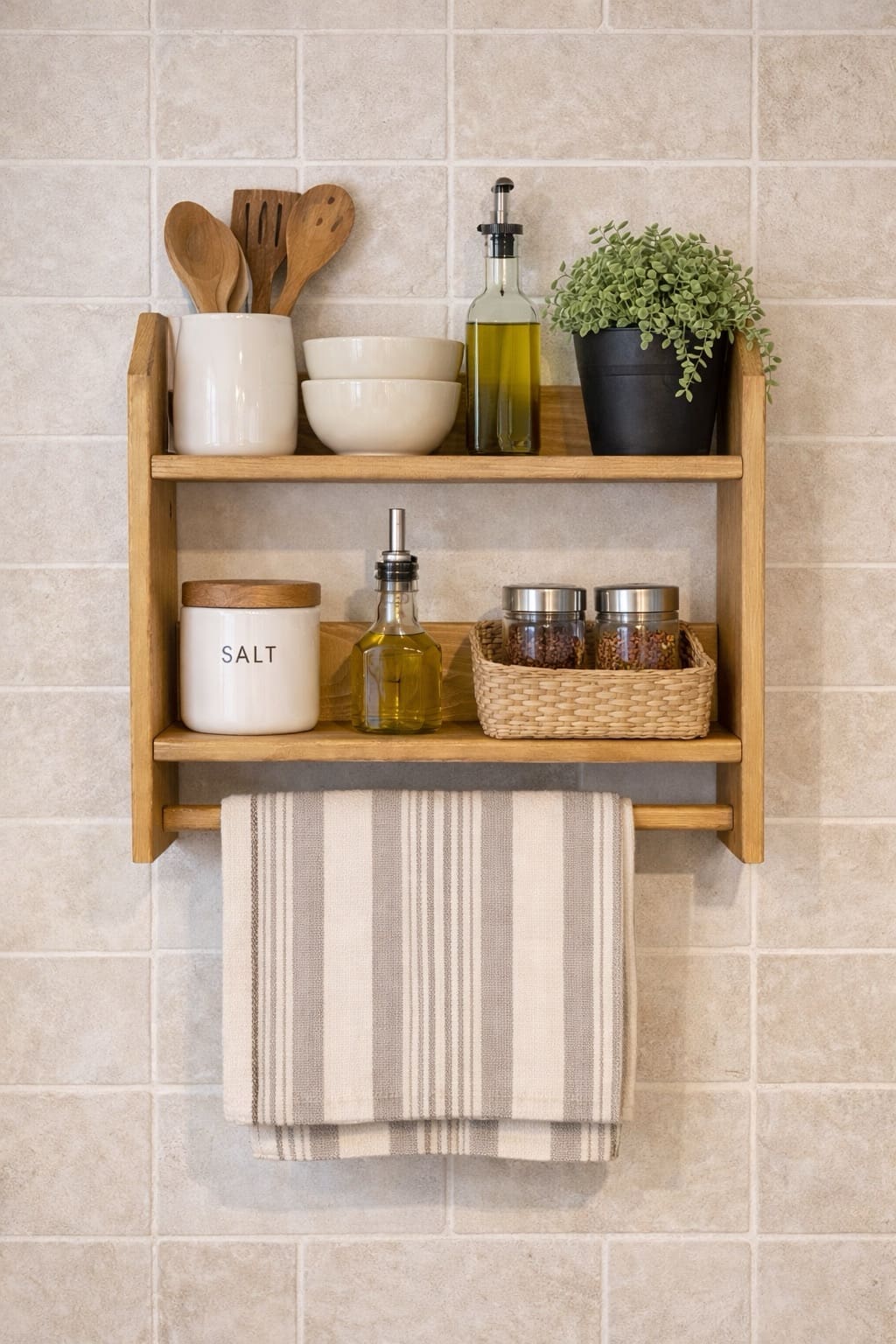
Kitchen. Wall storage over worktop storage. A wall-mounted unit with hooks for mugs and a shelf above keeps the counter clear, which makes the kitchen photograph better and clean faster. Keep the everyday items — mugs, tea, coffee, oil, salt — visible and grouped.
Bathroom. A shelf with a towel rail underneath does two jobs in one fixing. Guests need somewhere for wash bags that is not the edge of the bath, and towels that dry properly between uses reduce the laundry load and the damp smell that follows it.
Living space. One set of open shelves for books, board games and the welcome folder. This is where the local guides and walking maps should live, and it works far better than a drawer nobody opens.
Utility or porch. Boot storage and a drying rail if you are anywhere near a coast or a hill. Guests in walking country will bring wet kit back daily, and somewhere to put it is the difference between a five-star review and a note about the carpets.

The repairability argument
This is the part most furnishing guides skip, and it is the one that decides the five-year cost.
A let takes years of wear in months. Suitcases hit skirting boards, hooks get loaded with three coats at once, shelves get knocked as people move past with bags. The question is not whether a piece gets damaged — it is what happens when it does.
Solid wood is sanded, re-oiled and back in service the same afternoon. A scratch becomes patina, and a pulled screw can be plugged and re-drilled. Veneered board cannot be sanded, because there is nothing underneath the veneer to sand into, and a fixing point that has pulled out of MDF is permanently gone. In a let, replacement is not just the cost of the item — it is a changeover slot spent on an errand.
That maths is why a handmade piece that costs more up front is usually cheaper across the life of the property. Our guide to choosing reclaimed wood furniture goes into what to look for in the timber itself, and how to care for wooden furniture covers the annual re-oil that keeps it looking right.
Getting the character right
Guests book a property because of how it looks in eight photographs. Storage is in most of those photographs whether you intended it to be or not.
Mass-produced flatpack reads as generic in a listing photo, and generic is the one thing a holiday let cannot afford — it is competing with hundreds of near-identical properties on the same page. Visible timber grain, cast iron fittings and handmade joinery give a room a point of difference that costs nothing extra to photograph.
A word of caution against overdoing it. A let furnished entirely in one aesthetic starts to feel like a showroom. Pick two or three storage pieces that carry the character — the hook rail, the kitchen wall unit, one set of shelves — and keep everything else plain.
Practical specification notes
- Fix into structure, not just board. Guest loads are unpredictable. A piece with a continuous back rail lets you place fixings into studs or masonry rather than wherever the hooks happen to sit.
- Round off exposed corners at child height where you can. Lets take families, and families take toddlers.
- Avoid open shelving directly above a bed. It worries guests even when it is perfectly secure, and a worried guest writes about it.
- Standardise across multiple properties. If you run more than one let, using the same pieces means one spare on the shelf covers all of them.
- Seal the finish. Oiled or waxed timber copes with the humidity swings of a property that is heated intermittently far better than bare wood does.
If you need a run of shelving sized to an awkward alcove, our guide to choosing a wooden shelving unit covers spans, depths and weight. Everything we build in our Derbyshire workshop is made to order in solid wood, so sizing to a specific wall is normal rather than an exception.
Have a look through our handmade wooden storage, or get in touch if you are furnishing a property and want to talk through what would suit it. We are happy to quote for multiple matching pieces.
Frequently asked questions
What storage do you need in a holiday let?
Hooks at the entrance, open kitchen wall storage for everyday items, a bathroom shelf with a towel rail, one set of open shelves in the living space, and boot or drying storage if you are in walking country. Open and visible beats closed and tidy, because guests only use what they can see.
Should holiday let storage be freestanding or wall-mounted?
Wall-mounted, in most cases. It keeps the floor clear for cleaning between stays, photographs better in a small room, and avoids obstructing escape routes. Check your own fire risk assessment for anything on a hallway, landing or stairwell, as guidance on paying guest accommodation applies to those routes specifically.
Is solid wood worth it in a rental property?
Usually yes, because of repairability rather than appearance. Solid wood can be sanded, re-oiled and re-drilled when it is damaged, while veneered board and MDF generally cannot be. In a property with rapid turnover, a piece you can repair in an afternoon is worth more than a cheaper one you have to replace.
How do you stop guests putting things in the wrong place?
Make the right place visible. Open shelves, hooks and racks show their purpose without instructions, whereas a closed cupboard needs a label that guests will not read. Grouping related items together in one visible spot does more than any welcome-folder note.
Do I need to register a holiday let in England?
The government is introducing a mandatory national registration scheme for short-term lets in England. GOV.UK’s guidance on letting out a self-catering holiday home sets out the current position alongside planning, business rates and insurance, and your local council can confirm how it will apply to your property. This article is not legal or tax advice — check the official guidance.