Wooden Storage Crate Ideas for Every Room in Your Home
Wooden storage crates are one of those home basics that reward thinking about properly. At their simplest, they are a container: something to put things in, stack in a corner, and forget about. At their best, they are a genuinely flexible piece of storage that moves with you as your needs change, holds up to daily use, and improves how a room looks rather than detracting from it.
This guide covers how to use wooden storage crates around the home, what to look for when you are buying, and the practical details that make a difference over time.
Why Wooden Crates Work as Home Storage
The appeal of a solid wooden crate is not complicated. Wood is durable, it looks warm in almost any setting, and it ages rather than deteriorates. A crate made from solid pine or reclaimed timber will be in the same condition in ten years that it is today — possibly more characterful, but not worn out in the way that fabric bins, wicker baskets, or plastic boxes tend to become.
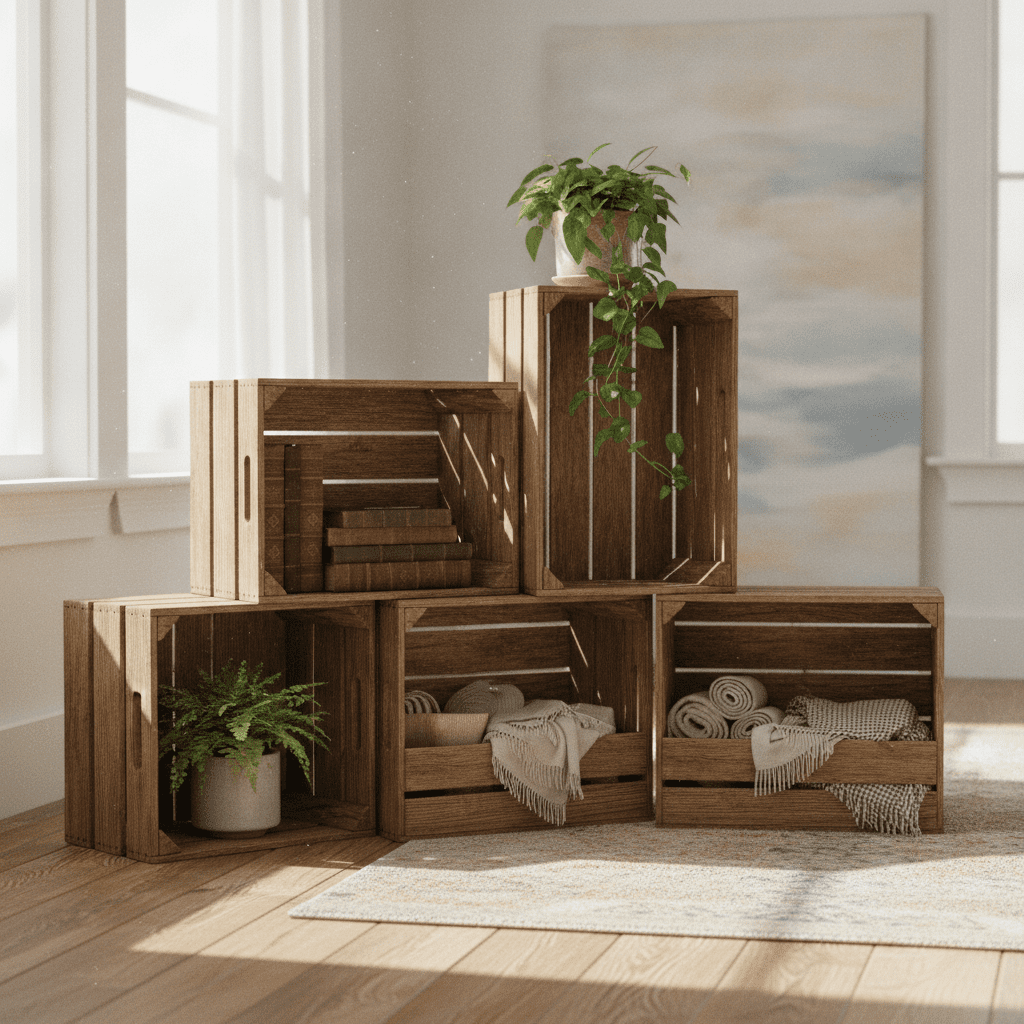
Stackability is the other practical advantage. Crates that stack reliably — without wobbling or needing brackets — can effectively turn any floor space into a vertical storage system. Three crates stacked give you the equivalent of a small shelving unit without the permanence of fixed shelving.
And because they are open-fronted or slatted, you can see what is inside without having to open a door, pull out a drawer, or lift a lid. For toys, craft materials, books, sporting equipment, or kitchen items, that everyday practicality makes a real difference.
Living Room: Blankets, Books, and Everyday Clutter
The living room is probably the most common place people reach for a wooden storage crate, and with good reason. A crate beside the sofa for throws and spare cushions keeps the room tidy without requiring a specific piece of furniture to do it. A stack of two or three crates in an alcove becomes an improvised bookshelf that works with the casual atmosphere of most living rooms rather than against it.
Low crates used as coffee table storage — a large crate on its side, turned to face outward, at a low height — can hold remote controls, a tablet, chargers, and the general accumulation of small things that ends up on a coffee table. It looks tidier than a tray and more interesting than a generic box.
For children’s toys in a family living room, crates are easier than drawers. Children can find what they want without tipping everything out, and tidying up is simply a matter of putting things back in the right crate. Label the outside if the contents change frequently.
Hallway: Shoes, Hats, and Everyday Essentials
The hallway is the room most likely to suffer from the lack of any proper storage for everyday items. A wooden crate near the door for shoes — not as a permanent solution but as a resting place for shoes currently in rotation — does more for a tidy hallway than most dedicated shoe storage solutions, because it is lower-commitment. You put shoes in, you take them out, you do not need to organise anything.
A crate at a higher level — on a shelf or on top of a larger piece of furniture — works well for hats, scarves, and gloves in winter. A separate one for sports kit, dog leads, or the particular category of object that accumulates near your front door in your household specifically.
The open-slat construction of most wooden crates also means muddy items air out rather than sitting in a closed container. For a gardening household or one with a dog, this is a practical advantage.
Kitchen: Produce, Bottles, and Small Appliances
A wooden crate on the kitchen worktop for fruit and vegetables is one of the most straightforward uses. It looks deliberately considered rather than an afterthought, it keeps produce organised without a specific produce bowl or rack, and the gaps in the slats allow air circulation, which helps things last longer.
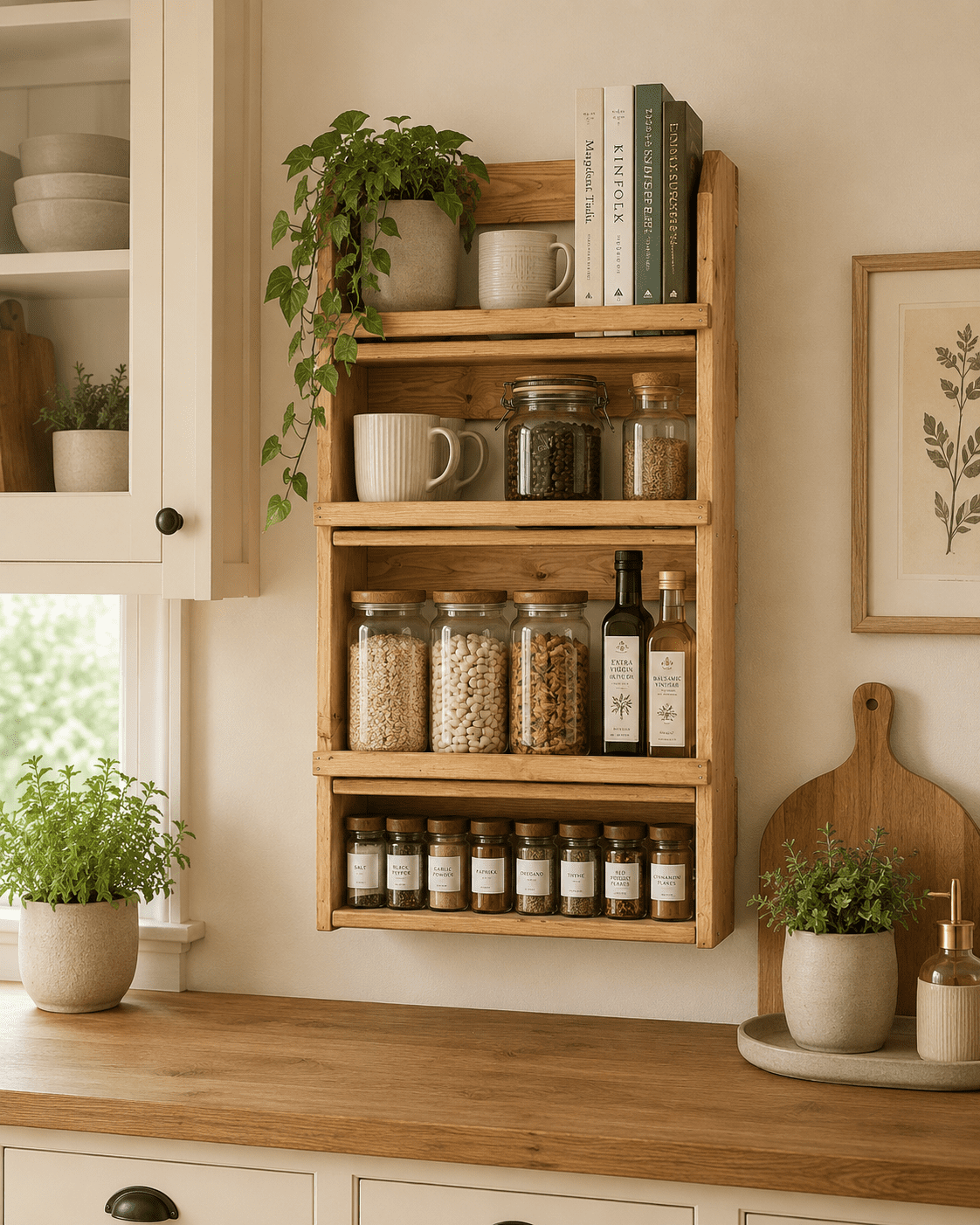
Under the worktop, crates can do the work of fixed kitchen drawers for things that do not need to be hidden: root vegetables, bottles of olive oil and vinegar, a collection of spice jars that do not fit in a dedicated rack. Pull one out, use what you need, push it back.
For small appliances that are used regularly but not constantly — a stand mixer, a juicer, a coffee grinder — a crate on a lower shelf keeps them accessible without them taking up permanent worktop space. It is easier to lift a crate out than to shuffle individual appliances around.
Bedroom: Wardrobe Overflow and Bedside Storage
The most useful place for a wooden crate in the bedroom is at the base of the wardrobe or beneath the bed — though for under-bed use, a crate with solid base boards rather than a slatted bottom keeps dust out better.
In the wardrobe, stacked crates can organise folded items more usefully than a single large shelf. One crate for jumpers, one for jeans, one for gym kit — it is easier than a general pile, and much easier than fitted drawers if you are renting or do not want to make permanent changes.
A crate on the bedside table — or as a bedside table itself, if the proportions work — can hold a reading lamp, books in progress, a notebook, phone charger, and the other items that tend to accumulate in that space. It is a more interesting option than a standard bedside drawer unit, and far more adaptable if your needs or your room layout changes.
Home Office: Cables, Stationery, and Files
Wooden crates work well for home office storage precisely because they impose a light kind of organisation without requiring total commitment. A crate for stationery and cables is more visually appealing than a drawer full of tangled leads, easier to access than a box with a lid, and large enough to hold the inevitable accumulation of things that belong near a desk without quite belonging on it.
For physical files and paperwork, a deeper crate — 30 to 40cm internal depth — can hold suspension files just as a filing box would, but in a form that looks more at home on an open shelf or under a desk than a cardboard bankers box.
Garage, Shed, and Utility Storage
The utility spaces where most household storage finally ends up — the garage, the garden shed, the understairs cupboard — are often where cheap plastic storage eventually fails. Wooden crates in these spaces hold up better to the weight of tools, garden equipment, sports gear, and the general miscellany of a household’s overflow.
In an outdoor setting, untreated wood will eventually weather and degrade. For garage or shed use, a crate with a simple wax or oil finish will last well. For outdoor use in more exposed situations, a naturally weather-resistant timber or a more robust treatment is worth considering.
What to Look For When Buying Wooden Storage Crates
A few things make a real difference over time:
- Solid wood construction — not MDF, chipboard, or ply. Real timber takes real weight and real use.
- Corner joinery — dovetail, box joint, or a simple overlapping butt joint with solid fixings is fine. What matters is that the corners hold under load without pulling apart.
- Base strength — if the crate is going to hold heavy items, the base needs to be as solid as the sides. A slatted base is good for ventilation; a solid board base is better for weight distribution.
- Consistent sizing — if you are planning to stack crates, they need to stack reliably. Crates from the same maker in the same dimensions will stack without rocking.
- Finish — a light wax or oil is all that is needed for indoor use. Something rougher suits a more utilitarian look; something smoother works better in living rooms and bedrooms where the crate is on display.
Custom Crates for Specific Spaces
Standard crate sizes work for most purposes, but if you have a specific space in mind — a particular shelf depth, a wardrobe cavity, an under-bed clearance — a custom size is worth asking about. A workshop that makes crates by hand can typically adjust dimensions without significant additional cost, and getting the sizing right from the start means the piece actually fits the space it is meant for.
Browse Handmade Wooden Storage
If you are looking for wooden storage that holds up to everyday use and looks the part while doing it, take a look at what we make at Our Home to Yours. All our pieces are handmade from solid and reclaimed timber in our Derbyshire workshop. Explore the collection or get in touch about a custom piece.